For most of the twentieth century, security of electricity supply in the Nordic countries was taken largely for granted. The grid was reliable, and backup for critical facilities meant a diesel generator that was tested once a month and rarely used. That picture has changed. Extreme weather events have caused long outages in rural areas, the security environment in Europe has shifted, and the energy system has become a recognized target for both physical and cyber attacks. Organizations responsible for critical services are now asking a harder question: not only whether they have backup power, but whether they can continue to operate for days if necessary. Microgrids offer a more capable answer than traditional backup solutions.
Beyond the backup generator
A conventional backup generator is a single point of failure. If it does not start, or if the fuel supply runs out during a prolonged outage, the facility goes dark. It also provides no value during normal operation, which makes it difficult to justify investments beyond the minimum required capacity.
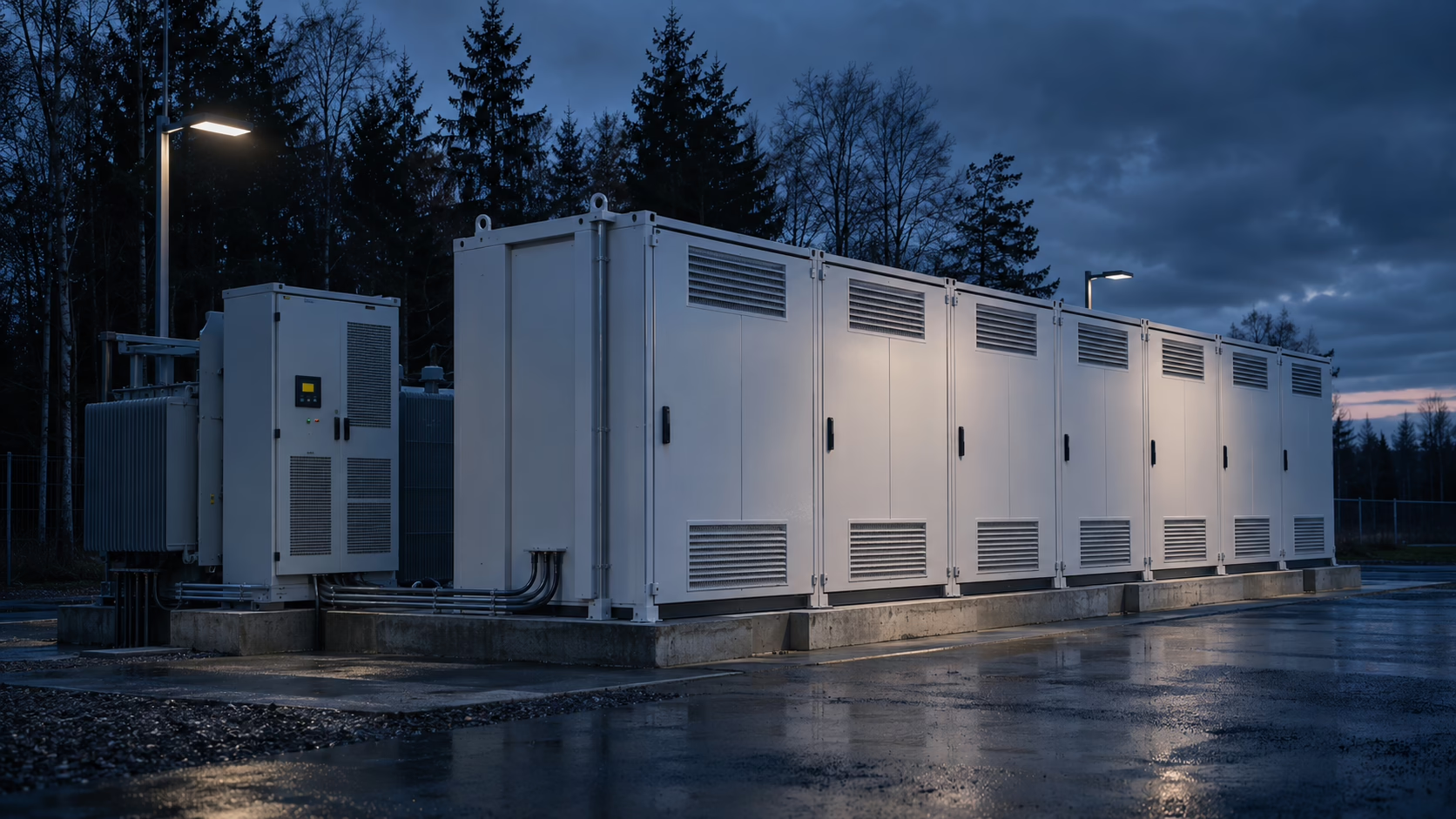
A microgrid with islanding capability combines several resources, typically solar or wind generation, battery storage, dispatchable generation and controllable loads, under a common control system. When the grid fails, the microgrid disconnects and continues to supply its own loads. Diverse resources reduce dependence on any single component or fuel. During normal operation, the same assets reduce energy costs and earn revenue, which improves the economics of the resilience investment considerably.
Seamless transition and stable island operation
The moment of disconnection is technically demanding. For sensitive facilities such as hospitals and data centers, even a brief interruption can be unacceptable. Grid-forming inverters, which can establish voltage and frequency on their own rather than following the grid, allow battery systems to take over almost seamlessly. Protection systems must be designed to work correctly in both grid-connected and islanded operation, because fault currents in an island are much lower than in the public grid.
Once in island mode, the microgrid must continuously balance generation and demand without external support. This requires real-time control that can respond to changes within milliseconds and an energy management strategy that looks hours or days ahead to ensure that energy reserves will last.
Load prioritization as the core of resilience optimization
In a long outage, available energy is limited, and the microgrid must decide which loads to supply. This is where optimization becomes critical. Loads should be classified in advance by their importance, from life-critical systems such as operating rooms and water treatment to essential functions, comfort loads and deferrable loads. The energy management system then supplies loads according to these priorities while maximizing the duration of supply for the most critical ones.
The optimization can be considerably more sophisticated than simple load shedding. It can reduce heating setpoints gradually rather than switching heating off entirely, delay non-urgent processes until solar production is available, and adjust the plan dynamically as forecasts and reserves evolve. The goal is to keep the most important services running as long as possible while maintaining as much normal functionality as the available energy allows.
Preparing before the crisis
Resilience is decided long before the outage begins. During normal operation, the microgrid must maintain an adequate energy reserve, which competes with the use of the battery for cost savings and market services. A good energy management system adjusts this reserve dynamically, increasing it when weather warnings or other risk indicators are present and releasing it for economic use when the risk is low.
Regular testing of islanding, clear operating procedures and staff training are as important as the technology itself. A microgrid that has never been tested in island mode should not be assumed to work when it is needed.
For hospitals, water utilities, municipalities, data centers and industrial sites with critical processes, microgrids represent a shift from passive backup to active resilience. They turn energy security from a pure cost into an investment that also pays back in everyday operation.